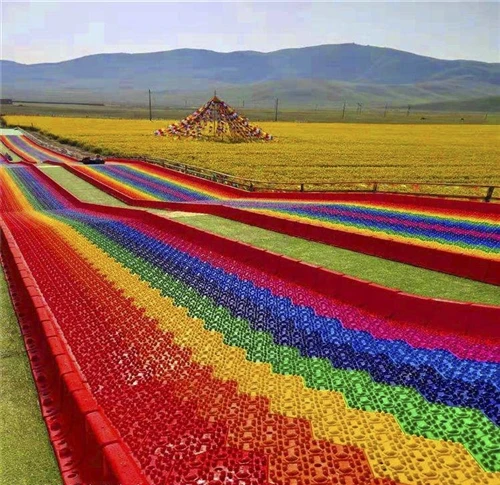
[International Outdoor Sports Facilities News] As a synthetic skiing surface that eliminates dependence on natural snowfall, dry ski slopes (also known as dry mats or synthetic ski surfaces) have gained increasing popularity in both professional training and public experience markets worldwide. According to the China Sporting Goods Export Council, export value of Chinese dry ski slopes and related components increased by approximately 38% year-on-year in 2025, with products entering over 30 countries and regions including Germany, the Netherlands, Sweden, Japan, South Korea, and the UAE. In the first quarter of 2026, orders from European, Middle Eastern, and Southeast Asian markets continue to show steady growth, reflecting strong global demand for year-round skiing solutions.
Core Technology and Structure
Dry ski slopes are made of modular pads manufactured from modified engineering plastics, featuring millions of micro-support columns on the surface that simulate the friction and resistance of real snow. Skiers using standard skis can perform turns, stops, and jumps, achieving over 85% similarity to the natural snow experience. Drainage channels at the bottom of each module allow rainwater to drain quickly, enabling rapid recovery after rain.
Modular Design for Quick Installation
Dry ski slopes utilize standardized panel units, typically 1m x 1m each, secured via snap-fit or bolt connections. Slope length can be customized from 50 to 500 meters based on site conditions, with width options ranging from 2 to 20 meters. Installation requires no heavy construction equipment, with a standard training slope taking approximately 10 to 15 days to complete.
Three Application Scenarios Drive Market Demand
Professional Training: Several European ski clubs have incorporated dry ski slopes into their summer training programs for skill refinement and fitness maintenance. A ski association in Germany reported that youth athletes training on dry slopes showed significantly faster technical improvement during the winter season compared to those who only train on natural snow.
Commercial Operations: An indoor ski center in the Netherlands features a 400-meter dry ski slope operating year-round, attracting over 120,000 skiing enthusiasts annually, with summer visitor numbers more than double those of traditional outdoor ski resorts.
Public Experience: An urban sports park in Dubai, UAE, introduced a small dry ski slope, offering year-round skiing experiences to local residents, with peak weekend ridership reaching 800 people per day.
Maintenance and Operating Cost Advantages
Compared to traditional artificial snow ski resorts, dry ski slopes offer significant cost benefits:
No snowmaking or refrigeration equipment required, saving approximately 60% on initial investment
Minimal water consumption, nearly zero annual water usage
Simple maintenance requiring only regular cleaning and module inspection, with annual maintenance costs below 10% of real snow resorts
Service life of 8 to 10 years, with a payback period of approximately 1.5 to 2 years
Safety Certification and Export Compliance
Exported dry ski slopes generally meet EU CE certification standards and come with bilingual installation manuals and safety operation guides. Manufacturers can provide site assessment, installation guidance, and operator training upon request. Product materials comply with EU REACH regulations and offer flame retardant and UV-resistant properties.
New Market Trends in 2026
Feedback from multiple manufacturers indicates that overseas buyers this year are placing greater emphasis on:
Site adaptability solutions: Feasibility assessments for installation on rooftops, flat ground, gentle slopes, and other terrains
Operational support services: Maintenance training, safety inspection procedures, and other operational guidance
Export Industry Advantages
Chinese dry ski slope manufacturers have established mature mold development capabilities, stable supply chains for modified engineering plastics, and rapid custom production systems. The typical lead time from order confirmation to production completion and sea freight arrangement is 30 to 45 days. Industry analysts note that the sustained popularity of dry ski slopes reflects the global trend toward "de-seasonalized, de-localized" skiing. From 2026 to 2028, exports in this category are expected to maintain average annual growth of over 25%, becoming an important growth segment for sports and leisure facility exports.